|
Join the Founding Class! The next 20 students to enroll only pay $3,000.
|

Our courses are designed to meet you where you are. The Entry-Level Course gives you everything you need to start a career in truss and structural component design learn the fundamentals, gain software skills, and get hands-on experience with real blueprints. If you want to build your expertise even further, the Advanced Course takes your skills to the next level, preparing you for more complex designs and higher-paying roles. Start with entry-level training and grow at your own pace learn more, earn more.
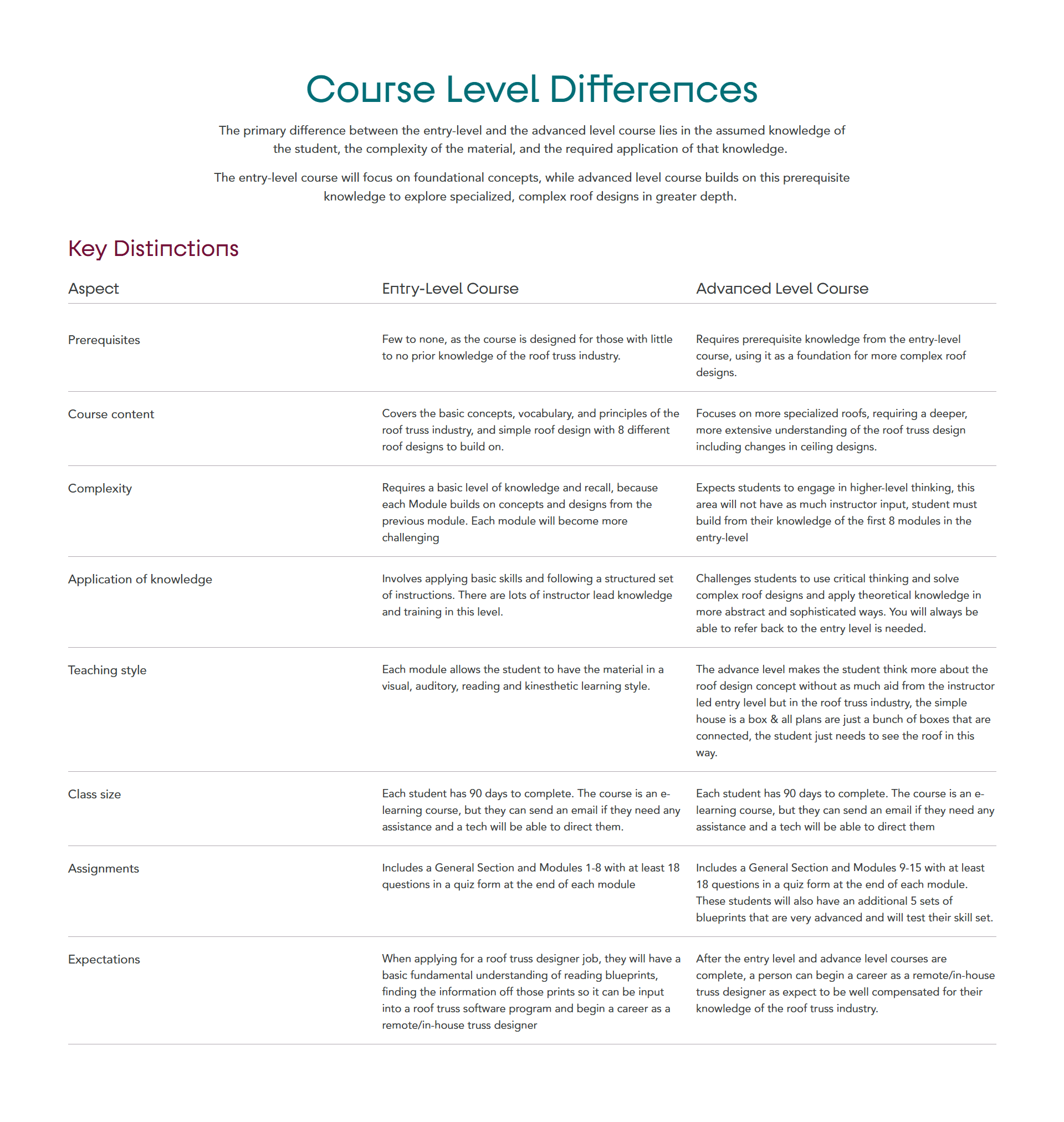
The primary difference between the entry-level and the advanced level course lies in the assumed knowledge of the student, the complexity of the material, and the required application of that knowledge.
The entry-level course will focus on foundational concepts, while advanced level course builds on this prerequisite knowledge to explore specialized, complex roof designs in greater depth.
Prerequisites
Few to none, as the course is designed for those with little to no prior knowledge of the roof truss industry.
Requires prerequisite knowledge from the entry-level course, using it as a foundation for more complex roof designs.
Course content
Covers the basic concepts, vocabulary, and principles of the roof truss industry, and simple roof design with 8 different roof designs to build on.
Focuses on more specialized roofs, requiring a deeper, more extensive understanding of the roof truss design including changes in ceiling designs.
Complexity
Requires a basic level of knowledge and recall, because each Module builds on concepts and designs from the previous module. Each module will become more challenging
Expects students to engage in higher-level thinking, this area will not have as much instructor input, student must build from their knowledge of the first 8 modules in the entry-level
Application of knowledge
Involves applying basic skills and following a structured set of instructions. There are lots of instructor lead knowledge and training in this level.
Challenges students to use critical thinking and solve complex roof designs and apply theoretical knowledge in more abstract and sophisticated ways. You will always be able to refer back to the entry level is needed.
Teaching style
Each module allows the student to have the material in a visual, auditory, reading and kinesthetic learning style.
The advance level makes the student think more about the roof design concept without as much aid from the instructor led entry level but in the roof truss industry, the simple house is a box & all plans are just a bunch of boxes that are connected, the student just needs to see the roof in this way.
Class size
Each student has 90 days to complete. The course is an e-learning course, but they can send an email if they need any assistance and a tech will be able to direct them.
Each student has 90 days to complete. The course is an e-learning course, but they can send an email if they need any assistance and a tech will be able to direct them
Assignments
Includes a General Section and Modules 1-8 with at least 18 questions in a quiz form at the end of each module
Includes a General Section and Modules 9-15 with at least 18 questions in a quiz form at the end of each module. These students will also have an additional 5 sets of blueprints that are very advanced and will test their skill set.
Expectations
When applying for a roof truss designer job, they will have a basic fundamental understanding of reading blueprints, finding the information off those prints so it can be input into a roof truss software program and begin a career as a remote/in-house truss designer
After the entry level and advance level courses are complete, a person can begin a career as a remote/in-house truss designer as expect to be well compensated for their knowledge of the roof truss industry.
Gain practical, industry-focused training while making an impact.
10% of all course profits are donated to facilities supporting special-needs children.
Save money, start your career sooner, and gain practical software skills and industry connections.